Harvest season is one of the most demanding periods for agricultural machinery. Combine harvesters, tractors, forage harvesters and other equipment often operate for long hours, under demanding conditions and with very little room for unexpected downtime. Agricultural machinery diagnostics plays an essential role during this period by helping technicians identify faults quickly and reduce unnecessary downtime.
Why Does Harvest Season Put Agricultural Machinery Under Greater Stress?
During harvest, machines are subjected to intensive use. Long working hours increase the load on different systems and can expose weaknesses that may not appear during normal operation.
Several factors can contribute to machinery faults:
- Extended operation of the engine and hydraulic systems;
- Heavy transmission loads;
- Continuous vibration and repetitive movements;
- Exposure to dust and crop debris;
- Continuous operation of electronic systems;
- High temperatures affecting certain components;
- Repeated work cycles and heavy loads.
As a result, a machine may operate normally for several hours before a fault suddenly appears.
The Main Systems to Monitor During Harvest
1. The Engine and Engine Management Systems
The engine is naturally one of the most heavily used components during harvesting operations.
Loss of power, unusual fuel consumption, starting difficulties or the appearance of a warning light can be the first signs of a problem.
However, the visible symptom does not always directly identify the cause.
The fault may originate from a sensor, damaged wiring, a power supply issue or the engine’s electronic management system.
This is why reading fault codes should be combined with an analysis of parameters and the technical information available for the affected system.
2. The Hydraulic System
Hydraulic systems play a central role in many agricultural machines.
Reduced performance, irregular movements, pressure loss or slower equipment response can indicate a hydraulic problem.
One common mistake is to immediately replace a pump or another expensive component without checking the entire system.
A structured diagnostic process can instead help identify the actual source of the problem, whether it involves pressure, sensors, solenoid valves, electrical power supply, parameters or hydraulic components.
3. The Transmission
During harvesting operations, transmissions are heavily loaded, particularly when machines need to maintain performance under demanding working conditions.
Abnormal gear changes, jerking, loss of traction or warning messages may indicate a transmission fault.
Here again, the fault code is only a starting point. It is important to understand how the system operates and check the different components that could be responsible for the fault.
4. Sensors and Electronic Systems
Modern agricultural machinery incorporates an increasing number of sensors and electronic control units.
These components monitor and optimize numerous functions, including the engine, transmission, hydraulics, PTO, harvesting systems and safety functions.
A simple communication fault or an incorrect sensor reading can therefore have a significant impact on machine operation.
Why Are Electronic Faults Difficult to Diagnose?
Modern agricultural machines are becoming increasingly connected and electronically controlled. Multiple control units communicate with each other through communication networks, while numerous sensors continuously transmit data.
As a result, diagnostics are becoming more complex.
A fault code does not necessarily mean that the component identified by the code is defective.
For example, a fault associated with a sensor may actually be caused by:
- A power supply problem;
- Damaged wiring;
- A poor connection;
- A grounding issue;
- A communication fault;
- Another component within the system.
Immediately replacing the component identified by the fault code can therefore lead to an incorrect diagnosis.
A structured troubleshooting approach helps technicians move from the symptom to the actual root cause.
Diagnostics: An Essential Step Before Any Repair
When a machine breaks down during harvest, the pressure is high. Every hour of downtime can disrupt the entire operation.
The priority is therefore to diagnose the problem quickly, but above all, accurately.
An effective diagnostic process can begin by:
- Identifying the exact symptom.
- Reading the fault codes stored in the control units.
- Checking parameters and measured values.
- Consulting wiring diagrams and technical information.
- Inspecting the relevant components.
- Carrying out the necessary measurements.
- Identifying the root cause before replacing any component.
- Checking machine operation after the repair.
This approach helps reduce unnecessary part replacements and the time spent troubleshooting.
Preventing Faults Before Harvest Season
The best time to discover a potential fault is not necessarily when the machine is already stopped in the middle of a harvesting operation.
Preparing machinery before the season can help identify certain problems before they become critical.
It is particularly useful to check:
- Stored fault codes;
- Engine and transmission systems;
- Hydraulic circuits;
- Electrical connections and wiring;
- Sensors;
- Communication systems;
- Required parameters and calibrations;
- Scheduled maintenance operations.
This approach can turn an emergency repair into a planned maintenance operation.
Why Does Access to the Right Technical Information Make a Difference?
When a fault occurs, technicians do not always have enough information based solely on the symptom or fault code.
Access to wiring diagrams, technical data, maintenance procedures, component information and troubleshooting guides can significantly simplify the diagnostic process.
For professionals working across different brands and models, having technical information centralized in one solution can also reduce the need to consult multiple sources and save valuable time during interventions.
Jaltest: Supporting Agricultural Machinery Diagnostics
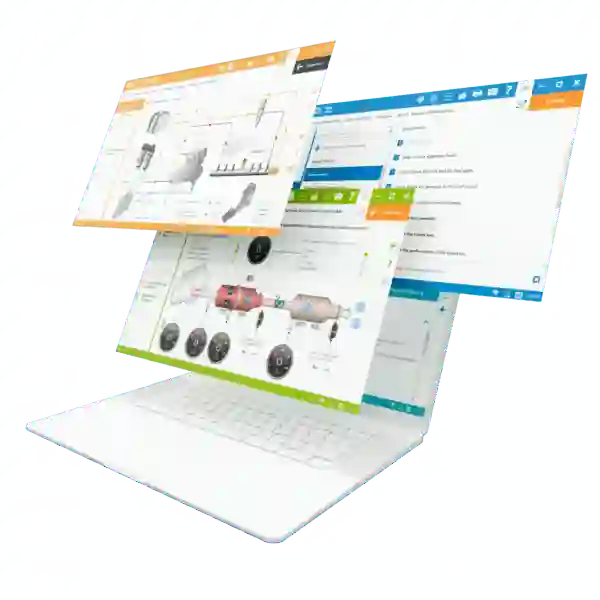
With Jaltest AGV, professionals have access to a solution dedicated to the diagnostics of agricultural machinery, covering tractors, harvesting equipment and other agricultural machines.
The platform provides features designed to support technicians during diagnostic, maintenance and troubleshooting operations.
The Jaltest 26.2 update further expands AGV coverage with new models and new maintenance, diagnostic and calibration functions. It also introduces additional wiring diagrams and SMART troubleshooting guides to help technicians identify faults more efficiently.
Conclusion
Harvest season is a real test for agricultural machinery. Intensive use can reveal mechanical, hydraulic or electronic problems that may have remained unnoticed under normal operating conditions.
To reduce downtime and improve repair efficiency, agricultural machinery diagnostics needs to go beyond simply reading a fault code.
Understanding the system, checking available data, carrying out the right measurements and accessing relevant technical information allow technicians to identify the actual cause of a fault and intervene more accurately.
A machine that is properly diagnosed is a machine that can get back to work faster.
Need Technical Information for Your Agricultural Diagnostics?
Discover Jaltest AGV and its features designed to support agricultural machinery diagnostics and maintenance.
Request your demo and discover how to optimize your interventions throughout the harvest season.